

June 22, 2026
Table of contents
The role has been open for months. The right candidate is still nowhere to be found, and every week without them is a week of missed momentum. If you're rethinking your hiring strategy, you're not alone.
The debate around outsourcing company vs local hiring has never been more relevant. With rising employment costs and a global talent shortage, founders are rethinking the default. Whether you're weighing local hiring vs outsourcing for the first time or reassessing a strategy that's stopped scaling, this guide will help you make a clear, confident decision grounded in real costs and genuine use cases.
What Does Local Hiring Mean?
Definition of Local Hiring
Local hiring means bringing employees into your business through a traditional in-house employment model: same country, same time zone, same labour market. These are full-time employees on your payroll, covered by local employment law, and working within your direct line of sight.
Advantages of Hiring Locally
It's the setup most businesses default to, and for good reason. Direct supervision, cultural alignment, and faster in-person collaboration are real advantages, especially for roles where presence and context matter. Getting those hires right, though, starts with a strong recruitment and staffing process.
Challenges of Local Hiring
But here's the thing: local hiring carries significant costs that rarely appear in a job offer letter. SHRM's 2026 Human Capital Benchmarking Report puts the average cost to hire a new employee in the US at $4,700–$4,800, before salary, benefits, or office overhead. ScaleTech's cost comparison research puts infrastructure costs alone at $10,000 to $30,000 per employee per year. Add a limited talent pool in competitive markets, and the true cost of hiring in-house vs outsourcing becomes hard to ignore.
What Is an Outsourcing Company?
How Outsourcing Companies Work
An outsourcing company connects businesses with dedicated remote employees who work as functional extensions of your team. Unlike a freelancer platform, a quality offshore staffing partner builds you a real team with vetted talent, built-in leadership, and operational continuity from the start. You're not plugging gaps. You're building offshore teams that are genuinely integrated into your business.
Types of Outsourcing Services
Today's remote staffing solutions cover customer support, digital marketing, web development, virtual assistance, finance, IT, and admin support. A 2024 Deloitte survey found that 80% of executives plan to maintain or increase investment in third-party outsourcing, with many extending it into sales and marketing.
Offshore vs Nearshore vs Onshore Outsourcing
| Type | Location | Cost Level | Best For |
| Offshore | Philippines, India, etc. | Lowest | Scalable roles, 24/7 ops, cost efficiency |
| Nearshore | Latin America, Eastern Europe | Moderate | Time-zone alignment, mid-cost savings |
| Onshore | Same country, different region | Higher | Compliance-sensitive, domestic focus |
For most SMEs, offshore outsourcing delivers the strongest ROI, particularly with a premium partner that prioritises talent quality, not just cost.
Local Hiring vs Outsourcing Company: Key Differences
Here's how the two models stack up across the factors that matter most to growing businesses.
| Factor | Local Hiring | Outsourcing Company |
| Cost | High (salary + benefits + overhead) | Significantly lower |
| Recruitment Time | Weeks to months | Days to weeks |
| Scalability | Slow, high friction | Fast, low friction |
| Talent Access | Limited to local market | Global talent pool |
| Infrastructure | Company-provided | Handled by provider |
| Employee Benefits | Employer-funded | Covered by provider |
| Flexibility | Low | High |
| Time Zone Coverage | Limited | Flexible coverage based on your needs |
Cost Comparison: Which Option Saves More Money?
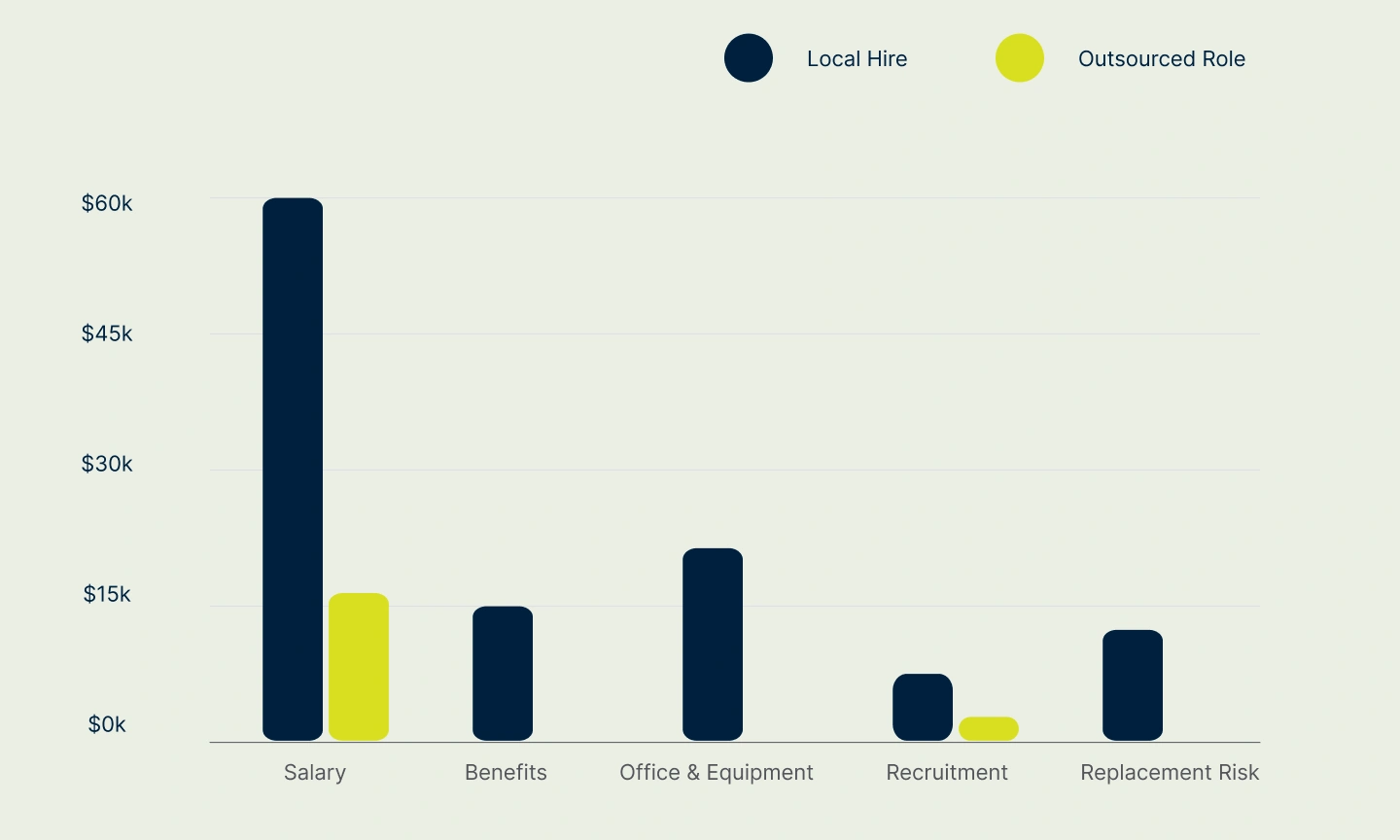
Most leaders underestimate how expensive a local hire really is. Layer in payroll taxes, health benefits, equipment, and office space. According to ScaleTech, replacing an employee alone can cost 50–200% of their annual salary, and the number climbs fast.
The real ROI of outsourcing sits in what you don't spend. Research from Genius suggests companies can save up to 85% on operational costs through outsourcing, with HR functions alone saving an average of $114,000 per year. For outsourcing for startups and lean SMEs, the outsourcing benefits for small business are clear: lower overhead, a reduced HR burden, and savings reinvested directly into growth.
Local Hiring vs Outsourcing: What Does a Hire Really Cost?
Estimated annual costs for a mid-level role (US market vs offshore equivalent)
When Hiring Locally Makes More Sense
Not every role belongs offshore. Leadership positions, C-suite roles, and client-facing executive hires often require physical presence or relationship-building that doesn't translate well remotely. Industries like healthcare, manufacturing, and retail have location requirements that make local hiring non-negotiable, as do highly sensitive roles involving regulatory compliance or legal liability.
When Outsourcing Is the Better Choice
For most other roles, offshore staffing vs local employees isn't a close contest. Startups, SMEs, and growing businesses find that outsourcing for startups accelerates hiring speed while keeping costs lean. Customer support, digital marketing, web development, graphic design, and data entry are all well-proven ground for offshore teams.
Here's what most people miss: the best offshore staffing partners don't just send workers; they bring structured offshore team models with built-in management and onboarding playbooks, making it one of the most cost-efficient ways to scale your team.
Biggest Risks of Outsourcing (And How to Avoid Them)
Communication Challenges
Async tools such as Slack, Loom, and project management platforms close most of this gap. Set communication protocols early and default to written documentation.
Quality Control Issues
Define outcomes before you hire. Use KPIs, output metrics, and regular check-ins from day one.
Security Concerns
Choose providers with documented data handling policies, NDAs, and access controls.
Time Zone Differences
Important Note: Time zones are only a problem when they're unplanned. Structure overlap hours into your engagement. Many businesses find the spread actually extends their operating hours.
Vendor vetting checklist: Track record and client references. Talent vetting process. Onboarding methodology. Security and compliance standards. Dedicated account management.
Questions to Ask Before Choosing Between Local Hiring and Outsourcing
Not sure which model fits your business? Use these questions as a quick gut-check before you commit. For a more thorough assessment, the Offshoring Readiness Checklist is a good place to start.
- What is my budget and what's the true fully-loaded cost of a local hire?
- How quickly do I need to scale?
- Does this role require specialised talent that's hard to find locally?
- Can this role be performed fully remotely?
- Do I need 24/7 operations or extended coverage?
If your answers lean toward speed and cost efficiency, this business outsourcing guide points clearly in one direction.
Hybrid Hiring: Combining Local Teams and Outsourced Staff
The most effective companies aren't choosing one model. They're building hybrid workforces: a lean local leadership core supported by high-performing distributed teams offshore. This combines the control of local hiring with the scalability of remote staffing in one flexible staffing model. A US-based agency, for example, might keep strategy leads local while running creative production and reporting offshore, scaling output without proportional cost increases.
Final Verdict: Which Hiring Strategy Is Right for Your Business?
There's no universal winner in the outsourcing company vs local hiring debate, but there is a right answer for your business.
Local hiring wins when you need physical presence, executive leadership, or compliance accountability. Outsourcing wins when you need speed, scale, and specialised skills at a fraction of the cost. Hybrid wins when you want both.
The real question isn't "should I outsource or hire locally?" It's: which roles deserve which model? Answer that, and you'll build a team structure that grows with you.
Ready to explore what the right offshore team looks like? People Avenue would love to be part of that conversation.
Frequently Asked Questions
References
- Qureos / SHRM — Cost of Hiring an Employee in the United States 2026
- ScaleTech — Cost Comparison: In-House vs. Outsourced Teams
- Prialto — 2025 Outsourcing Statistics and Trends
- Genius — Outsourcing Cost Savings: 29+ Compelling Statistics 2025
- KDCI Outsourcing — The Cost of Hiring in the US vs. Outsourcing